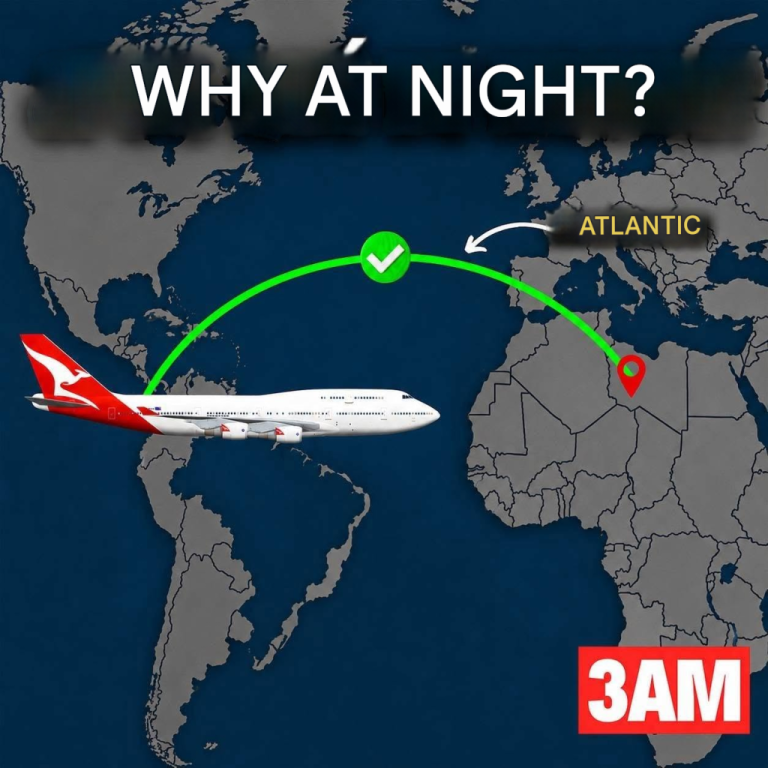
Every night, while millions of people sleep in the Americas, hundreds of planes take off for Europe, crossing one of the largest and busiest oceans on the planet in complete darkness. And although for many passengers it might seem more logical to travel during the day to enjoy the scenery, get better rest, or simply feel safer, airlines have other priorities. And those priorities move billions of dollars a year.
Geology
Destinations
The real reason so many transatlantic flights depart at night has nothing to do with fear of the ocean or hidden dangers in the sky. It all revolves around efficiency, money, international schedules, and how airlines turn every minute of flight into profit.
See more
Hospitals and Treatment Centers
Sleep Disorders
Schedules and Calendars
The North Atlantic: A Multi-Billion Dollar Air Highway
The routes between North America and Europe are some of the most important and profitable in the world. Cities like New York, London, Paris, Madrid, Amsterdam, and Frankfurt are connected daily by dozens of flights operated by giants such as British Airways, Delta Air Lines, American Airlines, Lufthansa, and Air France.
A single flight between New York and London can generate hundreds of thousands of dollars in revenue. Business and first-class tickets are usually extremely expensive, especially during peak seasons. For many airlines, these premium passengers are the real money.
Flights
Safe Travel
See more
Sleep Disorders
America
Flights
Although they occupy fewer seats than economy class, business travelers can account for more than half of a flight’s revenue. And they are precisely the ones driving the strategy of flying at night.
The real money is in the arrival time
⬇️For more information, continue to the next page⬇️
Most business travelers don’t want to lose an entire day traveling. They prefer to depart from America in the afternoon or evening, sleep during the flight, and land in Europe early in the morning.
Shipping and Logistics
Search for cheap flights
For example, a flight that takes off from New York at 8 p.m. can arrive in London around 8 a.m. the following day. This allows passengers to go directly to meetings, conferences, connections, or work activities without wasting valuable time.
See more
Geographic reference
Airspace and defense
Flights
Now imagine the opposite: taking off during the day and landing at night in Europe. The passenger would have to pay for a hotel immediately, sleep disoriented by the time change, and lose part of the next day recovering from fatigue.
For airlines, this makes the flight much less attractive to their most profitable customers.
Modern aircraft are designed to operate continuously.
Another huge factor is the intensive use of aircraft. A modern, long-range aircraft like the Boeing 787 Dreamliner or the Boeing 777 costs hundreds of millions of dollars. Having it grounded for many hours means losing money.
Aviation Sector
That’s why airlines try to keep their aircraft flying for as many hours as possible each day.
See more
Air Fleet
Aeronautical Technology
Air Routes
The ideal schedule is usually this:
Night flight from the Americas to Europe.
Brief grounding.
Daytime return to the Americas.
This way, the aircraft remains operational almost constantly.
Sleep Disorders
Furthermore, models like the Boeing 787 were specifically designed to reduce fuel consumption and make long-haul routes profitable. They consume significantly less fuel than previous generations and allow for transatlantic flights at lower costs.
Meanwhile, larger aircraft like the Boeing 777 or the Airbus A350 are ideal for transporting more passengers and cargo on high-demand routes.
Aviation sector
The clock favors night flights to Europe.